
The Real Scoop on New Home Developments in Denver
If you have been looking for a home in the Denver Metro area recently, you have probably noticed a pattern: resale inventory can be tight, and the competition for good listings is fierce. That is exactly why so many buyers are turning their attention to new construction. It’s not just about getting a shiny, untouched house; right now, new builds are filling a massive gap in the housing market.
However, the landscape here looks different than it did ten or twenty years ago. Most of the large-scale residential projects aren’t happening in downtown Denver—land there is scarce. Instead, the boom is happening in the suburbs like Aurora, Littleton, and Parker. And the vibe has shifted, too. We are seeing a move away from the traditional golf-course community model toward “agri-hoods,” tech-forward infrastructure, and neighborhoods built specifically around access to hiking trails and open space.
Buying New Construction vs. Resale in Denver
Deciding between a brand-new build and an established home is about more than just aesthetics; it’s a lifestyle and financial choice that comes with specific trade-offs in Colorado.
The biggest draw for new construction right now is the efficiency and the incentives. Colorado winters can be tough, and newer homes are built to much stricter energy codes than houses from the 1990s or early 2000s. You get better insulation, modern windows, and often smart-home tech baked right in. Plus, builders are motivated. To move inventory, many are offering rate buydowns—sometimes 1% or 2% below current market rates—which can make a monthly payment significantly more manageable compared to buying a resale home with a standard mortgage. You also get the peace of mind of a builder warranty, typically covering systems for two years and structure for ten.
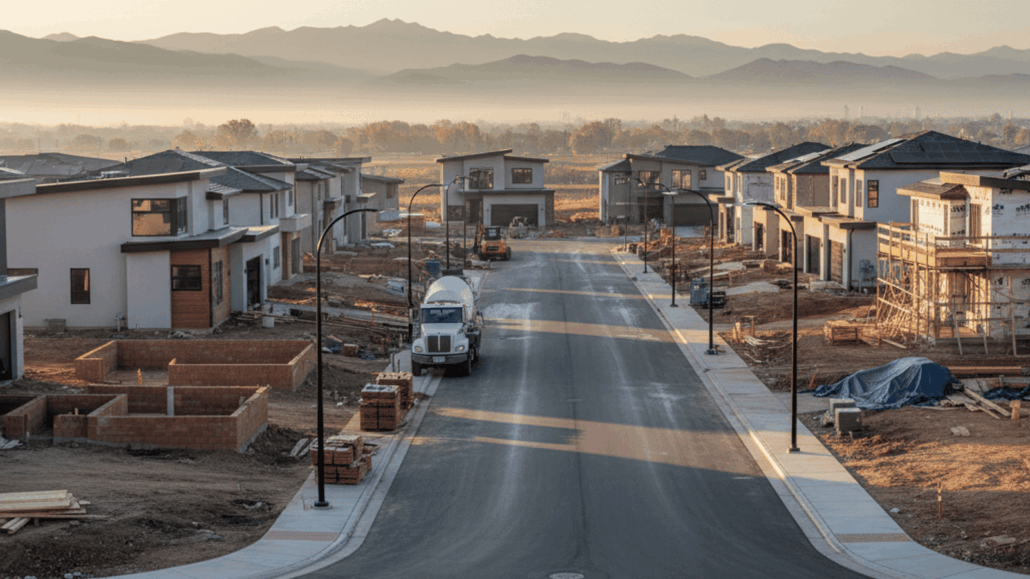
On the flip side, you have to be okay with living in a construction zone. For the first year or two, your morning commute might involve dodging cement trucks, and dust is a constant reality. You also need to watch out for the “hidden” costs. Resale homes usually come with fences, blinds, and backyard landscaping. New builds often don’t. You might close on the house and immediately need to spend $10,000 or more just to put in sod and a fence so the dog can go outside.
Top Master-Planned Communities in the Denver Metro
If you are open to the suburbs, the options are incredibly diverse. Developers are creating distinct “personalities” for these neighborhoods, so you can usually find one that matches your lifestyle.
Central Park Formerly known as Stapleton, this is the big exception to the “suburban only” rule. It is a massive urban infill project right in Denver proper. It feels more like a city neighborhood with higher density, walkable dining, and retail. While the community is nearing completion, the “North End” filings are still active with new inventory. It’s perfect if you want that new-home smell but don’t want to drive 45 minutes to get to a good restaurant.
Painted Prairie Located in Aurora near DIA, this community is making waves for its neo-traditional design. It is often described as an “agri-hood” because it prioritizes community gardens, massive parks, and shared outdoor spaces over private, walled-off backyards. It has a very social, front-porch culture and prices generally sit in the $500,000s to $800,000s range.
Sterling Ranch Down in Littleton, Sterling Ranch is huge and incredibly high-tech. Every home comes with LUMI fiber internet, and the community is designed with water conservation and sustainability in mind. It sits right at the edge of the foothills near Roxborough State Park, so the views are stunning. Prices here tend to run higher, often from $600,000 well into the millions.
Solterra If you want that hillside, Tuscan-village vibe, Solterra in Lakewood is the spot. It is built right next to Green Mountain, meaning you can practically walk out your door onto a hiking trail. It feels like a luxury resort, but inventory is limited and prices reflect that exclusivity.
The Aurora Highlands This is one of the largest projects in the metro area. Because of its scale, the entry price is often more attainable, starting in the $400,000s. They are focusing heavily on art installations and massive recreation centers to create a sense of place on the eastern plains.
Understanding Costs: Base Price vs. Final Price
One of the most confusing parts of walking into a model home is the price sheet. The number you see on the flyer is the “Base Price.” That gets you the house, but rarely the house you want.
First, you have Lot Premiums. If you want a corner lot, a cul-de-sac, or a view of the mountains, you are going to pay extra. In some premium neighborhoods, a view lot can add $50,000 to $100,000+ to the price tag.
Then comes the Design Center. This is where budgets often break. The base price usually includes standard finishes—think basic carpet and laminate counters. Most buyers end up spending 10% to 20% of the base price on upgrades like hardwood floors, quartz counters, or structural changes like adding a covered patio or an extra bedroom.
Finally, do not forget the Post-Closing Costs. As mentioned earlier, things like window treatments, backyard landscaping, and fencing are rarely included. You need to have cash set aside for these projects immediately after moving in and should factor these into the home cost.
The “Metro District” Factor: Taxes Explained
This is the single most important financial detail to understand when buying new construction in Colorado. You will often hear about “Metro Districts.”
A Metro District is a government entity—separate from the HOA—that issues bonds to pay for public infrastructure like roads, sewer lines, and parks. To pay back those bonds, the district charges residents an extra mill levy on their property taxes.
In an established Denver neighborhood, your property tax rate might be around 0.6% or 0.7%. In a new community with a Metro District, that total tax rate can jump to 1.1%, 1.5%, or even higher. That difference can add hundreds of dollars to your monthly payment.
The benefit is that you get resort-style pools, beautiful community centers, and well-maintained roads without the builder having to jack up the home prices even higher to pay for them upfront. However, you absolutely must check the “Service Plan” and tax records to know exactly what that mill levy looks like before you sign a contract. Note that unlike HOA fees, these Metro District fees are paid as property taxes, which can have different tax deduction implications.
Leading Builders in Denver
When you are touring these communities, you will see a mix of national giants and local specialists.
The big national names are everywhere. Lennar is famous for their “Everything’s Included” model, which simplifies the buying process by bundling features that other builders charge extra for. Pulte, Taylor Morrison, and Richmond American are also major players with inventory across the metro area.
On the luxury end, Toll Brothers and Shea Homes (who built much of Solterra) offer higher-end finishes and semi-custom options.
We also have some fantastic local and regional builders. Thrive Home Builders is renowned for their health and energy-efficiency focus, often building homes that are essentially power-plant neutral. Brookfield Residential is another notable builder offering very modern, architectural designs that stand out from the typical suburban look.
FAQs About Denver New Construction
Do I need a realtor to buy a new construction home in Denver?
Yes, it is highly recommended. The friendly sales agent in the model home represents the builder’s best interests, not yours. Having your own agent costs you nothing (the builder pays the commission) and ensures you have someone to negotiate contract terms, incentives, and explain complex documents like Metro District taxes.
How long does it take to build a new home in Denver?
It depends entirely on the status of the home. “Inventory” or “Quick Move-In” homes are often near completion and can close in 30–60 days. If you are doing a “dirt start”—where you pick the lot and build from scratch—expect a timeline of 6 to 9 months or longer, depending on weather and supply chains.
What is the difference between an HOA and a Metro District?
An HOA (Homeowners Association) generally enforces covenants (rules like paint colors) and maintains private amenities or common areas, funded by monthly dues. A Metro District is a taxing authority that funds major public infrastructure (roads, water lines) through your annual property tax bill.
Are property taxes higher in new developments?
Generally, yes. Because new developments rely on Metro Districts to fund their infrastructure, the total mill levy is usually significantly higher than in older, established neighborhoods. You get new amenities and roads, but you pay for them through that higher tax rate.